Blog Posts

How to Draw… a Flower #4

A Three Dimensional (3D) Flower

In this weeks blog we are continuing with more flower drawings.

We are in the last week of The Wildlife Trusts #30dayswild, and we love celebrating the rich habitats and wildlife we have on our doorstep here at Heathlands.

To draw your 3D flower…

You will need:

  • Paper
  • A pencil
  • A pen
  • An eraser / rubber

How to draw a wildflower – cow parsley:

  1. Using your pencil, begin by drawing an oval.
  2. Draw a curved line under this as shown, to create a “bowl” or “goblet” shape.
  3. Add a smaller bowl shape to the bottom of this.
  4. Draw parallel lines down from the bottom bowl to create a stem for your flower.
  5. Draw the flowers “sepals”. The part of the flower between the stem and the petals.
  6. Draw your individual petals, following the curve of the bowl shape. Do the foreground petals first and add the background one after.
  7. Add “stamens” growing out from the centre / inside of your flower.
  8. Complete your drawing by going over your finished sketch with a fine liner. Allow this to dry for 5-10 minutes before rubbing out your pencil lines.
  9. And you are done! You can add colour now if you wish.

You can watch our video tutorial here:

How to Draw… Flower #3

Flower Heads from Different Angles

For our final mini tutorial on how-to-draw flowers, we are looking at how we can change the perspective of our drawing, through simple changes in our drawing technique.

We hope you are all enjoying the #30dayswild activities that are being shared on the Heathlands Facebook Page and we would love to see any of the creative things you have been up to.

You will need:

  • Paper
  • A pencil
  • A rubber
  • A pen

How to draw a flower heads from different angles:

  1. We are going to start by drawing our flowers first this time. Begin by drawing two (2) simple flowers with long petals like in picture one (1).
  2. Next draw a third flower, this time draw the petals at the top and bottom a little shorter, and the petals on one side a lot shorter.
  3. For our final two (2) flowers, draw the centre as “little domes” and only draw petals coming off the side or off the bottom. This way the are facing a different direction, sideways or upwards!
  4. Finally connect your flowers with some stems and add foliage like we did in our first flower tutorial which you can find here: How to Draw… Flower #1

You can watch our video tutorial here:

How to Draw… Flower #2

A Petalled Flower with Lobed Leaves

Welcome to our latest “hot-to-draw” mini tutorial! These instructions and video’s are all about improving our drawing skills and thinking differently about the simple things we can draw to make them even better.

This week sees the start of our #30dayswild activities with The Wildlife Trusts here at Heathlands, so drawing flowers seems very appropriate!

This is the second in our flower series and this time we are thinking about how to draw petals in an alternative way.

You will need:

  • Paper
  • A pencil
  • A rubber
  • A pen

How to draw a petalled flower:

  1. Begin by drawing two (2) stems connected together like a long U shape, flaring out slightly at the top.
  2. Pencil in two outwardly curvy triangles at the top of each stem.
  3. Add a domed top to each triangle and make a smaller triangle at the bottom of each with a line. You can also add extra stems and flowers if you wish.
  4. Draw long, curved, upside-down triangles to form the petals of your flower heads. The colour in the bottom triangle.
  5. Complete your flower by adding long lobbed leaves and foliage!

You can watch our video tutorial here:

How to Draw… Flower #1

A Wildflower – Cow Parsley

Next in our mini-series of “how-to-draw” tutorials, is flowers!

Here at Heathlands we are blessed with an amazing 8 & 1/2 acres of woodland, pasture, gardens and wetland. We have a huge variety of wildflowers, we are cataloguing these on our Facebook here: Wildflower Post

It is also June, which means we have started our #30dayswild activities here at Heathlands. You can join in at home by going to The Wildlife Trusts website.

You will need:

  • Paper
  • A pencil or a pen

How to draw a wildflower – cow parsley:

  1. Begin by drawing two (2) stems. One main stem and a secondary stem coming off the first.
  2. Add six (6) curved stalks radiating out from the end of each stem. The centre two (2) stalks should be the longest and the outer two (2) the shortest.
  3. Draw two (2) or three (3) foliage stalks coming off the main stems.
  4. Add delicate feather-like foliage to the stalks from step three (3).
  5. Complete your wildflower by adding little “stars” * to the tips of your flower stalks.

You can watch our video tutorial here:

How to Draw a Knotwork Wreath

Step by step instructions for an interlacing wreath

We have bee concentrating on our drawing skills at Heathlands lately and this post is no different.

This time we are making things a little more complicated with a knotwork wreath, made of two interlocking or interlacing circles.

You will need:

  • Paper
  • A pencil
  • A pen
  • Something round or a compass
  • A ruler

How to draw a your knotwork wreath:

  1. Begin by drawing a circle.
  2. Make 12 evenly spaced point around your circle. Much like the points on a clock.
  3. At each point, draw an arrow. Your arrows should all point in the same direction.
  4. Inside each arrow create a little diamond.
  5. From inside your arrowheads, draw curved lines to the previous arrow and finish them parallel to them. See images for help. Repeat all the way round.
  6. From the open ends of your arrows, draw more curved lines, meeting up with the diamonds of the previous arrowheads. Again see images for help. Repeat until complete!

You can colour or decorate your wreath as you wish. I have yet to experiment, however, I believe that if you use an odd number of arrows to start with, you will end up with one continuous interlacing circle, rather than two!

You can watch our video tutorial here:

How to Draw a Heart #3

Heart Wreath with Cursive Text

Our current series of mini drawing films is concentrating on how to draw hearts. For this how-to we are learning how to draw a shamrock of knotwork hearts.

You will need:

  • Paper
  • Coloured pencil or a crayon in green
  • Metallic marker pen

How to draw your layered hearts:

  1. Begin by drawing a large “scribbly” heart with you green crayon or pencil.
  2. Next add lobe shaped leaves all the way around your heart.
  3. Finally add your desired message over the top of you wreath with a metallic marker. You could print out a font to trace or draw your lettering in pencil lightly and go over in marker when you are happy.

You can watch our video tutorial here:

How to Draw a Heart #2

Heart Shamrock Knotwork

Welcome to a new mini art instruction!

Our current series of mini drawing films is concentrating on how to draw hearts. For this how-to we are learning how to draw a shamrock of knotwork hearts.

You will need:

  • Paper
  • A pencil or a pen

How to draw your layered hearts:

  1. Begin by drawing four heart with the bottom points, pointing at each other.
  2. From the bottom of each heart, draw short lines on the same path as one of the side of the hearts pointing towards the heart counter clockwise to it, then draw a small square in the centre.
  3. Draw parallel lines to the right hand side of each heart joining the square in the centre.
  4. Repeat step 3 for the left hand sides.
  5. Your heart knotwork shamrock is complete!

You can watch our video tutorial here:

How to Draw a Heart #1

Layered Hearts

In our latest set of mini art films we are learning how to draw hearts in different ways. Our first film shows you how to draw a series of four (4) hearts that are layered and interconnected.

You will need:

  • Paper
  • A pencil or a pen
  • Coloured felt tips / pencils / crayons

How to draw your layered hearts:

  1. Begin by drawing a heart, you can do this in pencil first, or go straight in with your colouring medium.
  2. Draw a second, smaller heart, down and to the right of the first.
  3. Next draw a line with a fine liner or black felt tip, the shape you are drawing is the left side of a heart. It should start in the middle of the large heart and end below it.
  4. Repeat step three but drawing the right side of a heart. You should start above the small heart and the lines should join at the bottom.
  5. To complete your drawing, from the left-hand “half a heart” begin drawing the other side and as you come down loop the line in a figure of eight (8) back up and over itself to form the right hand side of the “half a heart” on the right.

You can watch our video tutorial here:

How to Draw… Star #3

3D Knotwork Star

In our latest mini video we are learning to draw another star. This week we are doing something a little more complicated, a three dimensional (3D) knotwork star.

Each week we will present a new shape, idea or technique, with the intention of building our skills and having fun at the same time.

You will need:

  • Paper
  • A pencil or a pen

How to draw a simple knotwork star:

  1. Begin by drawing a series of five (5) lines or “spokes”, radiating out from each other, with a very small pentagon in the centre.
  2. Pick one of your five (5) spokes to start with, then draw a line parallel to the next spoke clockwise from the top, then another line from the middle. Close these two (2) new lines off and draw another line down towards the the next spoke round again. This can be seen in picture two (2)
  3. Repeat step two (2) until you have completed your star!

You can watch our video tutorial here:

How to Draw… Star #1

Simple Knotwork Star

We are starting a series of mini video’s here at Heathlands, all about how to draw!

Each week we will present a new shape, idea or technique, with the intention of building our skills and having fun at the same time.

You will need:

  • Paper
  • A pencil or a pen

How to draw a simple knotwork star:

  1. Begin by drawing a pentagon.
  2. From your pentagon base, continue your lines outwards and then hook back towards the opposite edge of the pentagon. Do not join these lines up!
  3. Follow the contours of these lines further out. Starting from the

You can watch our video tutorial here:

How to Draw… Star #2

Complex Five Pointed Star

This is the second in our new mini series on how to draw.

Each week we will be presenting a new shape, idea or technique, with the intention of building our skills and having fun at the same time.

You will need:

  • Paper
  • A pencil or a pen

How to draw a complex five pointed star:

Follow these four easy steps to draw your star…

  1. Begin by drawing three (3) intersecting lines. They should cross each other about 1/3 from the centre point.
  2. Add a further two (2) lines so that you have five (5) short “spokes” & five (5) long.
  3. Outline or join up your ten (10) spokes.
  4. Your star is complete and ready to colour in if you wish.

You can watch our video tutorial here:

Drawing with a Difference #3

We are continuing with our new Drawing with a Difference series today, promoting the idea of drawing without traditional mediums or tools.

For this instalment we are exploring pixel art further, by using paper collage as our drawing method.

You can find our live video here:

https://www.facebook.com/Heathlands.Cumbria/videos/738797261074582

What you will need:

  • Colourful paper cut into equal sized squares
  • Card to paste your collage to
  • A glue stick
  • Squared paper
  • Pencils or felt tips to plan your design

How to make your pixel art collage:

  1. Plan out your design using the squared paper and felt tips. You can always use google for inspiration!
  2. Cut enough squares of equal size to complete your artwork.
  3. Find the centre of your design, then mark the centre of your card.
  4. Starting with the centre 4 squares, begin gluing your design.
  5. Continue working outwards until you are done!

Drawing with a Difference #2

To follow on from our first drawing with a difference session we recorded a short video of continuous line drawing, but with a difference!

Instead of using traditional drawing tools, we played with PVA and wool.

What you will need:

  • Slightly watered down PVA glue
  • Pasting brush for glue
  • Colourful yarn, wool or string
  • Colourful cards
  • Scissors
  • A glue stick

How to make your continuous line drawing:

  1. Create a background for you picture using coloured card and your glue stick. We made a very simple landscape.
  2. Paste PVA over the entire area you intend to draw on.
  3. Cut lengths of wool and draw your shapes, subject or objects by laying the wool into the glue.
  4. Your fingers may get messy, if you are struggling to not lift the wool by accident as you lay it, use the end of a pencil or paintbrush to help position the wool.
  5. Adding extra glue on top may also help.
  6. Once dry, paste over the entire picture again.
  7. Your picture is done!

You can find the video instructions here:

Drawing with a Difference #1

Here at Heathlands we love to explore new and exciting ways we can express ourselves with Arts & Crafts.

With this in mind we are starting a new series of live demonstrations, short videos and blog posts, for you to have a go at “drawing with a difference”. So, what do we mean by this? Quite simply we mean drawing, with anything but pencil and paper.

Our first session went live yesterday, Monday 27th February 2023 and the link to the video can be found here: https://www.facebook.com/Heathlands.Cumbria/videos/1359988764543889

Drawing with a Difference Session #1 – LEGO!!!

The inspiration for the first of our sessions is pixel art, a method for creating images with small squares or pixels.

For this activity we decided it would be really fun to use Lego Dots, as our pixels as they are movable and easy to use. We also decided to draw a polar bear, Monday was international polar bear day!

What you will need:

  • A Lego base plate
  • Lego Dots
  • Your imagination!

How to make your dot / pixel picture:

  1. First you need to decide what you are going to “draw”.
  2. select your colours and start with key features or if you prefer an outline of your idea.
  3. Fill in your work, moving your pixels if needed.
  4. Repeat as much as you like!

Below are some examples of pixel pictures we have made, including a few step by step images of the polar bear.

Step by step polar bear, you can also find a stop-motion here: https://youtu.be/3QcqkYIWqNU

Origami Ninja Star

We thought for this weeks 5 minute craft we would have a bit of fun!

The origins of the bo-shuriken or ninja throwing star in Japan are still unclear, despite continuing research. This is partly because shurikenjutsu was a secret art. Thankfully the art or origami is an easy and accessible way to make your own stars!

What you will need:

  • 4 pieces of 15x15cm origmai paper
  • A work surface to fold on

How to make your throwing stars:

  1. With wrong side up, fold your paper in half diagonally and unfold.
  2. Fold each edge of the square into the middle fold line. Repeat for all four sides creating a squashed diamond.
  3. Fold in half along your original fold line, making a long triangle.
  4. Fold this in half again so that both sharp points come together.
  5. Repeat steps 1-4 for all 4 pieces of paper.
  6. Slot each point over the next forming a square and pull the points out.

Secret Valentines

If like us you are a romantic at heart this fun and easy Valentine’s Day card is a whimsical craft that you can easily do at home!

Wax relief or resist, is a simple and versatile technique where a white crayon or oil pastel is used to draw “invisibly” on white paper, then painted over to reveal the design. It is very important that it is an oil pastel and NOT chalk.

For this craft we thought having the recipient reveal the design for themselves was a fun and unusual quirk for a card.

You will need:

  • An A5 piece of white card or watercolour paper, folded in half
  • An A6 envelope
  • A white wax crayon or white oil pastel
  • Water soluble colouring pencils
  • A pen to write your message inside

How to make your card:

  1. Using your crayon or oil pastel, draw your design heavily onto the front of the card.
  2. With your water soluble pencils, colour in randomly around your design. Be careful not to colour over the crayon or pastel. You may need to check where you drew but tilting the card to see the design.
  3. Write a message inside, including instructions to “colour in” the front with water.
  4. Deliver your card!

Recycled Card Gift Tags

Here at Heathlands we are always looking for way to recycle, reuse and repurpose things instead of throwing them away.

Christmas can create quite a lot of waste and we decided to look for ways to reduce the load of rubbish and recycling we were putting to the curb.

One of our activities has been made possible by finding some fantastic die cutters / punches for repurposing our Christmas cards!

This craft also works with any old greeting cards just as well.

What you need:

  • Old greetings cards
  • Tag punch / cutter
  • Corner punch / cutter
  • Circular cutter
  • Scissors
  • Ruler
  • Pencil
  • Hope punch
  • Narrow ribbons or twine

How to make your gift tags:

  1. For using the tag punch: using a ruler and your pencil, measure out strips of card at your desired size. Our gift tag punch cuts at 1.5, 2 and 2.5 inches. Slide the card into the punch face down and press hard.
  2. For making rectangular tags: cut your card to the desired size and select which corner size you are punching. Punch all four corners.
  3. For circular tag: using a circular cutter, place over desired section, hold firmly and while pressing down rotate the cutter.
  4. For ALL tags: not use your hole punch and punch each tag for string / ribbons.
  5. Cut a piece of ribbon or twine around 4 inches long. Double it over. Pass it through the punched whole and put the loose ends through the loop.
  6. Your gift tags are complete!

You can also see our video here:

https://www.facebook.com/Heathlands.Cumbria/videos/531733505691518

Easy Origami Rabbit!

This week we have been inspired to make origami rabbits for the start of the Chinese New Yea of the Rabbit!

Below are very simple instructions for our beginners bunny and we have also linked in our live Facebook tutorial for a more advanced fold!

You will need:

  1. Origami paper
  2. Googly eyes
  3. Scissors
  4. A flat work surface

How to make your rabbit:

Here is the video for the simple rabbit:

https://www.facebook.com/Heathlands.Cumbria/videos/744156427389129

In the mean time here is our more advanced rabbit fold:

https://www.facebook.com/Heathlands.Cumbria/videos/849419989649623

Origami Witch

It’s been a while since we shared an origami fold, so here is a video of Helen T making an origami witch.

You will need:

  • Lightweight coloured papers
  • Black felt tip pen
  • Scissors
  • Glue stick

How to make your witch:

Witches hat and face:

  1. Take your first square of paper for your hat. Fold it in half diagonally and unfold.
  2. Fold each side inwards to form a kite shape, aligning the outer edges with the diagonal fold. Unfold again.
  3. Next fold in the out corners to match the new diagonal folds. See the video for more clarity.
  4. Now fold the side in again to make the kite shape once more.
  5. Fold the sharp point down to meet its opposite corner.
  6. Then fold the sharp point back up with a little less than a cm difference. Then fold this over again. This forms the brim of your witches hat.
  7. Turn your work over, fold the bottom point up to meet the fold on the reverse.
  8. Fold in either side to form the shape of your witches face.
  9. Trace around the shape of your witches face on a scrap of paper. It should be a trapezium.
  10. Tuck this into the folds of the witches face / hair and draw on a face.

Witches body and broom:

  1. Take your second square of paper. Fold it in half diagonally each way, unfold, then fold in half edge to edge one way.
  2. With the paper in half, fold down the folded edge toward the centre, creating a triangle.
  3. Next take the folded flaps and turn the the edge in the centre up to the edge of the triangle. Do this on both sides.
  4. Turn your work over. Fold down the the outer top edges to form a square, turn your work over again.
  5. To form your witches feet, turn the bottom two points up and out over.
  6. Next make your broom, cut a small square of brown paper and cut multiple slits into it to form bristles. Cut a strip of paper and using a glue stick, wrap the bristles around one end.

Assemble your witch!

  1. Using your glue stick, stick your witches head to the body.
  2. To complete, stick the broom to one of your witches arms.

And you’re done! Make multiple to create origami bunting or change the size of your paper to create a witch / warlock family.

How to Draw a Turtle

Today is #worldturtleday, so we thought we would do a simple how to draw instruction for our Arts Live session over on Facebook.

The video will be linked below.

What is World Turtle Day?

World turtle day is an observance day on the 23rd of May every year to raise awareness of Turtles and the challenges that they face; climate change, plastic pollution and habitat destruction for example. To find out more visit https://www.worldturtleday.org/

What you will need to draw your turtle:

  • Plain paper
  • Pencil
  • Black felt tip
  • Rubber / eraser
  • Something to colour with

How to draw your turtle:

  1. Using the template below, trace your shapes together.
  2. Outline with black pen and rub out pencil lines.
  3. Colour your turtle in!

Origami Pigeons

We love to break a stereotype here at Heathlands, and today we thought we look at the common and much unloved pigeon.

Commonly thought of as a pest and carriers of disease, nothing could be further from the truth. The pigeon is an intelligent animal, with excellent recognition skills, as well as superb navigation abilities.

There are 5 regognised pigeon / dove species in the UK with the “feral” pigeon being a decendant of the now rare Rock Dove. You can find out more here:

https://www.countryfile.com/wildlife/birds/guide-to-pigeons-and-doves-of-the-uk/

Today’s craft activity is how to make origami pigeons and doves.

What you will need:

  • Pale blue / grey / cream origami paper
  • A black felt tip pen

Instructions:

Finger Puppet Penguin

Today is world Penguin Day!

World Penguin Day is celebrated on the 25th April each year, as this is roughly the date of this amazing creatures annual, northward migration. The day is a celebratory and educative initiative, that encourages people to learn more about penguins and their environment, how important they are to our ecosystems and the threats they face.

World Penguin Day is the perfect chance to learn more about these fantastic and fascinating creatures. Read up on the different species of penguin around the world and dig out some fun facts to share with your friends and family.

Did you know that there are 18 species of penguin and of these 11 are considered to be globally threatened?

For fun, we thought for World Penguin day we would make a cute finger puppet!

What you will need:

  • Felt in black, white and yellow
  • Black embroidery thread
  • PVA or Copydex
  • Needle
  • Scissors
  • Pencils
  • Googly eyes

How to make your penguin:

Please refer to the photos below.

  1. On the black felt using a white pencil, draw around your index finger with a cm space all round.
  2. Fold the felt over and cut out two shapes at the same time.
  3. On the white felt using any pencil, draw around you index finger again up to you middle knuckle.
  4. Cut one shape out.
  5. Cut a small triangle for a beak out of the yellow felt.
  6. Choose two googly eyes.
  7. Glue white felt, beak and eyes to one of you black felt pieces.
  8. Using black mercies cotton or embroidery thread, sew the two black pieces of felt together around the edges. Leave to bottom open.
  9. You can use blanket stitch or whip stitch.
  10. Your puppet is complete! Happy World Penguin Day!

Tissue Paper Suncatchers

This week we have another suncatcher craft for you! This time we’re using tissue paper and PVA.

What you need:

Black sugar paper and some things to draw around
Colourful tissue paper
Slightly diluted PVA Glue and pritstick
Paint Brush
A poly pocket to work on
Scissors

How to make your suncatcher:

  1. To make your suncatcher frame, use two round objects and draw around them.
  2. Cut your paper frame out.
  3. Place your ring inside your poly pocket.
  4. Cut your tissue paper into little squares.
  5. Paint PVA glue on the pocket over the inner edge of the frame but not the outer edge.
  6. Place your tissue paper piece all over the glue and paints another layer of glue on top.
  7. Allow to dry.
  8. Peal the tissue paper off the pocket and glue it to your frame with pritstick.
  9. Hang your suncatcher in a window and enjoy.

Malteser Rocky Road

This sweet treat is a really simple treat to make and can be adapted in so many ways.

Ingredients:

  • 250g dark chocolate
  • 200g milk chocolate
  • 50g white chocolate (to decorate)
  • 200g maltesers
  • 75g mini marshmallows
  • 100g biscuits
  • 200g salted butter
  • 150g golden syrup

Method:

  1. Line a square 8 inch cake tin with baking parchment.
  2. Add dark & milk chocolate, butter and golden syrup to a heavy bottomed saucepan and melt together.
  3. Allow to cool for around 10 minutes.
  4. Break up biscuits and add all of the remaining ingredients, other than the white chocolate, to the cooled mixture.
  5. Pour out into cake tin and smooth over.
  6. Melt the white chocolate in a microwave in short bursts and drizzle over to decorate.
  7. Chill in the fridge for 3-4 hours or over night.
  8. Cut into desired size pieces and enjoy.

A Sunflower for Ukraine

We are devastated by the awful events unfolding in the Ukraine. At Heathlands we have always strived to support others who need help, whether this is fundraising for Children in Need, staffing the local Poppy Appeal table or raising awareness through our activities here and online.

To show our solidarity with the Ukraine, this week we are making paper sunflowers, to display in our windows both at Heathlands and at home. Below are the instructions for you to make your own.

What you will need:

  • x1 sheet of A4 yellow card
  • x1 sheet of A4 bright blue card
  • x1 sheet of A4 blue sugar paper
  • Scissors
  • Glue stick
  • Pinking shears (optional)
  • 2-3cm large circular whole punch (optional)
  • Pencil
  • Something circular to draw around, about 10cm in diameter

How to make your Sunflower:

  1. On your yellow card, draw around your circular object and cut disc out.
  2. Draw an elongated petal shape, cut out and use this as a stencil. Draw around in 16 times and cut out.
  3. Fold all of your petals in half.
  4. Using your blue card and paper cut out approximately 8 small discs in each colour. These will be your sunflower seeds.
  5. Cut a long wiggling stem for your sunflower from the blue card.
  6. Cut a heart shaped leaf or two from your blue card or paper. You can use pinking shears to do this to give a realistic leafy look. This is optional.
  7. Glue your petals around the edge of the large yellow disc like the rays of the sun.
  8. Alternating between blue card and paper, glue the “seeds” in the middle in a spiral pattern, working from the outside, in.
  9. Glue your leaves to the stem and glue your stem to the back of the flower head.
  10. Your sunflower is complete!

Spring Origami Flowers

Known as “Kusudama”, these beautiful flowers are simple to make and can be adapted for lots of occations.

You will need:

  • x5 sheets of origami paper per flower
  • x1 pipe cleaner
  • x1 lollipop stick
  • Glue stick

How to make your flower:

  1. Taking a 15x15cm or 10x10cm square of origami paper, with the wrong side up, fold it in half diagonally.
  2. Fold the outer tips inwards and upwards to meat the point at the top.
  3. Fold these flaps back down so that the long centre edge meets the outer shorter edge.
  4. Open this flap out and fold down to create a kite shape.
  5. Fold the top of the kite shape down and back up again as shown in the pictures.
  6. Fold the kite shape inward in half like below.
  7. Glue the left flap to the right flap to create your petal cone.
  8. Repeat 4 more times.
  9. Glue together with pipe cleaner twisted on itself to make a nodding head and glue this to the lollipop stick for its stalk.

Christmas Gnome Decorations

These adorable Christmas tree decorations are not only cute, they’re really easy to make!

You will need:

  • Colourful felt
  • Wool / yarn
  • Wooden beads, red, pink and natural work well
  • Tiny buttons
  • Paper raffia
  • Glue gun
  • Scissors
  • Chalk
  • Plastic bodkin

How to make your gnome:

  1. Make a tassel by wrapping the wool around your hand until you are happy with how big it is. Thin yarn may take up to 40 wraps, think around 20.
  2. Cut a semi circle of felt out and use the glue gun to make it into a cone for his hat. Make sure you leave a little hole at the tip.
  3. Tie a loop of paper raffia around the middle of your tassel and pull through the hat, glueing with the glue gun in place.
  4. Glue a bead into the front inner edge of the hat for his nose.
  5. Glue on buttons to his hat to decorate.
  6. And you’re done! Hang him on your tree.

Crackerless Christmas Crackers

Its beginning to look a Christmas here at Heathlands!

We adore this time of year, and we are always trying to think of ways to make Christmas traditions more inclusive for the individuals we work with.

Loud noises are often not appreciated by people with autism and learning disabilities, so we came up with this idea for a crackerless Christmas cracker.

You will need:

  • Wrapping paper
  • Toilet roll cardboard inners
  • Ribbon or paper raffia
  • A4 white paper
  • A4 colourful paper of your choice
  • A4 white card
  • Scissors
  • Sellotape
  • A ruler
  • A pencil
  • A black felt tip pen
  • A writing pen

How to make your crackerless cracker:

  1. Cut a piece of wrapping paper off the roll enough to wrap around your toilet roll tubes.
  2. This piece should be enough to make 2 crackers if you half it from top to bottom. Our piece was 35 x 19cm.
  3. Cut a 3cm strip off the long side of your colourful paper.
  4. Write BANG!!! at one end on both sides.
  5. Concertina the strip, leaving an inch at the blank end for sticking down.
  6. Stick the strip inside of the tube using the end you didn’t concertina.
  7. Place your tube on one long edge of your wrapping paper, in the middle and sellotape.
  8. The end of the tube that has the BANG!!! concertina to it is your “winning end”.
  9. Tape the winning end of your tube to the wrapping paper.
  10. Tape the concertina end of your BANG!!! to the wrapping paper close to the other end of the tube.
  11. Roll the wrapping paper around the tube and tape shut. Tape the soft end of your paper closed as well.
  12. Cut two 4-5cm strips of card from the short end of your A4 white card.
  13. Curl a piece of card and insert it into the loosing end of your cracker and tape secure.
  14. Pinch the wrapping paper space between your tube and the piece of card and tie shut with a ribbon / raffia bow.
  15. Add a gift / sweets / a hand written joke into your winners end of the cracker.
  16. Close like in steps 13 and 14.
  17. Your crackerless Christmas cracker is done!

Bonfire Night Pinwheels

Bonfire Night is a beloved event here in the UK but Fireworks are not for everyone. Here at Heathlands we have a number of individuals who do not enjoy the loud bangs and whistles that come with Bonfire Night.

With this in mind we thought we would share a fun craft activity to make a Catherine Wheel full of sparkle and no noise.

You will need:

  • Shiny card – we used gold
  • A ruler
  • Scissors
  • Drawing pin
  • Paper stick or paper straw
  • Loose tinsel (the kind you throw on your tree)
  • Sellotape

How to make your pinwheel

  1. Measure your card along the short side.
  2. Using your ruler, mark the same length on each long side. Join the marks up and cut to make your card into a square.
  3. Again, using your ruler, mark the centre of your square by lining up the opposite corners.
  4. From each corner draw a line towards the centre 10cm long.
  5. Cut along each of these lines.
  6. In the centre and on every other point on your card make a small hole with your pin.
  7. Bend each point with a hole into the middle, using your pin to join them all up, and put the pin through the middle and into your straw.
  8. Gather 8 pieces of tinsel and tape together in the middle. Fold this bundle in half and tape to one of the points of your pinwheel. Repeat this for all four points.
  9. Your silent Catherine Wheel is complete!

Firework Printing

This week we are really looking forward to Bonfire Night!

To go alongside our Firework Pinwheels, we have made this printing activity for you to make your very own indoor fireworks display!

You will need:

  • Large black paper
  • Acrylic / poster paints
  • Cardboard tubes
  • Scissors
  • Glitter (optional)
  • A paintbrush
  • Paint tray

How to make your fireworks display:

  1. Using your scissors, cut your cardboard tubes down from one end in narrow strips, between a 1/4 to a 1/3 the way down.
  2. Fan your cut tube out.
  3. Spread your paint evenly on a paint tray. Dip the tube into the paint and press onto your paper.
  4. Sprinkle with glitter.
  5. Repeat until you are happy.
  6. Using your paintbrush, paint “trail” lines for the rockets shooting up into the sky.

Everlasting Jack O’lanterns

We love Halloween at Heathlands! Dressing up, carving pumpkins and caramel apples are all favourites.

The thing about pumpkins though… they don’t last forever. So! We thought we’d share with you how you can make an everlasting pumpkin!

You will need:

  • 1 piece of A4 orange card
  • 1 piece of A4 green card
  • Two split pins / paper fasteners
  • Scissors
  • A ruler
  • A hole punch or something to make holes in your card
  • A pencil
  • A black felt tip pen

How to make your pumpkin:

  1. Along the long sides of your orange card make marks in 3cm intervals and join them up using your ruler.
  2. Cut 8 strips of orange card.
  3. Cut a piece of green card for a stalk. We have put a picture below to show the S shape we used.
  4. Put holes in each end of every strip of card and in one end of the stalk.
  5. Put the stalk onto a paper fastener first and then thread all of the card board strips on at one end. Spilt the pin and flatten it out.
  6. Use the other paper fastener to connect together all the other ends.
  7. Twist / turn the layers out to form your pumpkin.
  8. Use your felt tip to give your pumpkin a face!

Spooktacular Halloween Lantern Jars

We are getting in a spooky mood here at Heathlands with the run up to Halloween. Today we’ve mean making tealight jars, inspired by Helen W’s tissue paper lantern jars that can be found here!

You will need:

  • A glass jar
  • PVA Glue watered down. Around 50:50 is perfect.
  • A paintbrush
  • Tissue paper. White and black for a ghost and orange and black for a pumpkin.
  • Scissors
  • A pencil
  • Some scrap paper or newsprint to work on.

How to make your Halloween jar:

  1. Decide what style of jar you are making and pick appropriately coloured tissue paper.
  2. Water down your PVA and mix well.
  3. Cut your tissue paper into 2-3cm squares.
  4. Paint a little of your jar at a time and make one even layer of tissue paper all over. Making sure there are no gaps.
  5. Use a hairdryer if you want to speed up the drying process, or leave overnight to set.
  6. Fold a small piece of black tissue paper in half and from the folded edge draw a mouth. Also draw an eye shape. Cut these out, the mouth should be one piece and symmetrical, you should have two eyes that match.
  7. Glue these on and paint another layer of glue all over. Leave to dry.
  8. Put a tealight in your jar and place it in your window!

Fire Breathing Dragons!

It’s been a while since a blog post. So I thought I would share this fun craft with you all, how to make fire breathing dragons!

You will need:

A toilet roll inner
Tissue paper in fiery colours
PVA
Paint, palette & brushes
Pompoms – x2 white and x2 mini ones to match your dragon
Scissors

How to make your dragon:

  1. Begin by painting your toilet roll inner in whatever colour you would like it to be. We chose greens and reds for ours.
  2. You can add texture for its scales by doting a different colour of paint on or, waiting for it to dry and drawing texture on with pens.
  3. Cut your tissue paper into 10-15cm long strips with tapers at one end.
  4. Paint a 2cm strip of PVA inside one end of your dragon tube and start sticking your fiery tissue paper in. Add more glue as you add layers.
  5. Glue your two white pompoms at the other end of the tube for eyes and your mini pompoms above the fire for his nostrils.
  6. Paint dots onto your dragon for pupils.
  7. Allow to dry and blow through the tube to animate your fire!

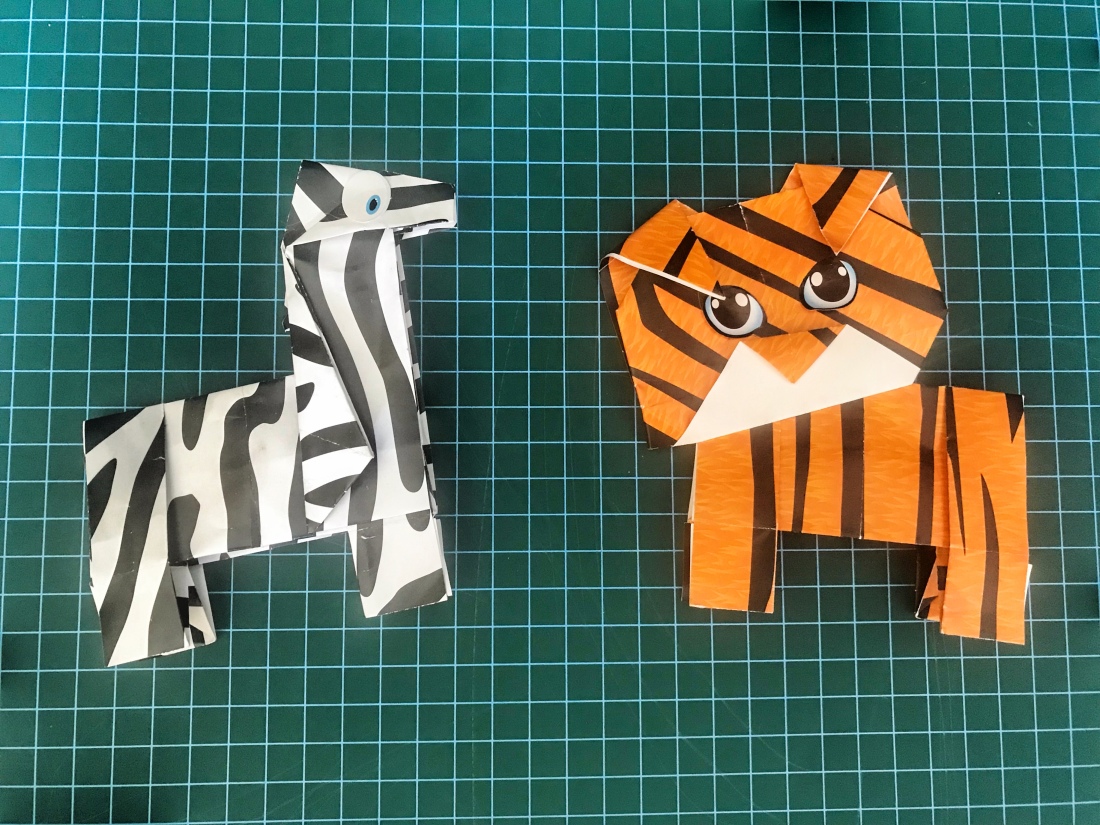
Origami Zebra and Tiger

Here is another origami instruction from Monday Arts Live, this time a zebra and tiger!

You will need:

2 squares of paper and a surface to work on
Pritt Stick
Paint, palette & brushes if you are decorating your paper with paint, or you can use pencils, felt tips or ink.

How to make your lion:

  1. For your zebra decorate two of your squares of paper with black wiggly stripes and the same on orange paper for your tiger.
  2. Follow the instructions below for how to fold, or follow the link to our Facebook Art Live video for how to decorate your own paper.

Eva Stamps!

This week at Heathlands we have been making stamping blocks! These are really simple to create and are a great way of getting creative and decorative with your crafts.

We’ve made our stamps to be interchangeable, meaning that the number of stamps you can create are only limited by the scale of your imagination.

To make your stamps you will need:

  • Eva foam / funky foam
  • Sticky back velcro / hook and loop tape
  • A block of wood
  • Staple gun
  • Scissors
  • Pencil / pen

To use your stamp you will need:

  • Flat paint tray
  • Poster paints / acrylics
  • Paper / material to stamp on

How to make your:

  1. Stick the hook side of your velcro onto your wooden block.
  2. Staple to secure at each end.
  3. Draw your desired shapes for your stamps onto the eva foam making sure not to make them any larger than the block of wood.
  4. Cut out your shapes and add the loop (soft) velcro tape onto the back. Remember that your stamp shapes will reverse or “mirror” when you are stamping. So draw letters and numbers the wrong way round.
  5. You are ready to print! Pick your favourite paint colours and add an even layer to your stamp and get printing. You may need to gently rock your stamp to get it even.
  6. Remember not over load your stamp or it will slide.
  7. Have fun!

Other idea’s for simple stamps include: leaves, flowers, simple shapes, birthday balloons, snowflakes and Christmas tree’s.

Origami Giraffe

We’ve been working on our origami again here at Heathlands. This week we’ve decorated paper and folded a giraffe. You can follow our instructions below and watch our live video as well.

You will need:

2 squares of paper and a surface to work on
Pritstick
Paint, palette, brushes and a sponge if you are decorating your paper

How to make your giraffe:

  1. Decorate your squares of paper with a yellow fur texture, allow this to dry, then use a rough sponge and brown paint to create splodges for your giraffe.
  2. Follow the instructions below for how to fold, or follow the link to our Facebook Art Live video.

Minion Memo Board!

Here at Heathlands we will soon be opening our brand new and renovated portacabin! It was designated “blue bubble”, however we wanted to make the space as warm and cheery as possible. So, the space will be decorated with both blue and yellow. Thus Minnion Bubble was born.

With that in mind, I thought for this weeks craft we would make something for our new space. A memo board inspired by minions! We’re using lightweight denim and yellow ribbons for our theme, but you can use any colours or patterns you like.

What you will need:

A wooden board or piece of MDF

Fabric

Ribbon

Quilt wading

Decorative upholstery tacks

Picture hanging fixings

Staple gun

Scissors

Screwdriver or cordless drill with phillips head bit

How to make your memo board:

  1. Make sure your board has no sharp edges and sand off anything you think might snag your fabric.
  2. Place your board on top of your wadding, leaving a gap around the edge so that you can wrap the wadding around to the top.
  3. Cut the wadding to size.
  4. Cut your fabric to the same size or every so slightly larger.
  5. Wrap the wading and fabric around the board, and starting from the centres of the sides, working out, staple them down. Periodically check that the fabric is stretching evenly.
  6. Starting from one corner, staple your ribbon from the back, and wrap it diagonally around the front of the board. Cut the ribbon after each wrap. Work along the board, making sure to leave even gaps.
  7. Repeat step six in the opposite direction to create a diamond pattern with your ribbons.
  8. Use your decorative upholstery tacks to pin down the ribbons at each point where they cross.
  9. Attach hanging fixtures to the back, put up on your wall and enjoy!

Beaded Suncatcher

A few weeks back we decided to follow up our #30dayswild nature dreamcatcher craft from The Wildlife Trusts with a suncatcher.

The craft was for one of our Facebook art live shows, so I thought I would write a blog post with instructions on how to make your own.

What you need:

A sturdy stick to hang your beads around
Wire
Glass beads
Twine
Small pliers / wire cutters
Scissors

How to make your suncatcher:

  1. Cut 5 lengths of wire, x1 30cm, x2 25cm and x2 20cm
  2. Place a small bead about 2cm from the end of each wire, turn the wire back on itself and twist together.
  3. Thread each wire with your favourite glass beads, leaving 4cm to wrap around your stick.
  4. Arrange your wires: small, medium, long, medium, small, along your stick, around 3cm apart.
  5. Cut a length of garden twine around one and half to two times the length of your stick and tie it to either end of your stick.
  6. Hang your suncatcher in a window and enjoy.

Nature Dreamcatcher

As part of our #30dayswild activities from The Wildlife Trusts, we decided to follow one of their instructions that you can find here.

Making a your dreamcatcher is simple and fun. It’s also a great opportunity to get outdoors and explore nature. Go for a walk and collect natural materials to make your dreamcatcher with.

What you will need:

Three sturdy sticks
Garden twine
Natural materials to decorate – hag stones (stones with holes in), feathers, shells, leaves, flowers, grasses etc
Scissors

How to make your nature dream catcher:

  1. Arrange your sticks in a triangle and tie together with twine. Leave one with a long tail to hang.
  2. Create a pattern of your choice in the triangle with twine. It can be a simple or as complicated as you like.
  3. Once you’re happy with your twine, start decorating! You could also suspend some of your materials from pieces of twine from the bottom.
  4. Think about adding flowers for colour and herbs for fragrance.
  5. Hang your dreamcatcher and change out the fresh materials when they wilt.

Pom-Pom Bumble Bee

Bees are really important to our whole eco-system so we thought we’d show our love of them by making a fluffy pom-pom version.

You will need:

  • Cardboard
  • Yellow and black yarn
  • Small amount of white net fabric (or similar)
  • Black pipe cleaner
  • Wiggly eyes
  • Scissors
  • Circular templates
  • Glue (PVA or a hot glue gun work best)

Step 1.

Use your circular templates (we’re using a roll of tape and a small pot) to draw two ‘donuts’ onto your cardboard. They should be the same size as each other. Cut them out.

Step 2.

Hold your two ‘donuts’ together and we’re going to start wrapping yarn around, as shown in the pictures. We’re going to wrap the ‘donut’ in black and yellow sections so we get a nice stripy bee! Try and wrap as evenly as you can, working around the circle.

Step 3.

When you’ve wrapped so much yarn the centre is full you’re ready for the next step. Very carefully, use your scissors to cut around the edge of the pom-pom, as shown.

Step 4.

Now it becomes clear why we used two cardboard circles; cut a piece of yarn and slide it in-between the cardboard circles. Wrap it around the middle and tie it as tightly as you can.

Step 5.

You can now remove the cardboard rings and give the bee a trim if needed to tidy her up!

Step 6.

From the white fabric cut two wing shapes and glue them onto the back of the bee. Bend the pipe cleaner in half and glue onto the top of the head. You may also want to bend the ends into a curve. Finally, glue the wiggly eyes onto the front of the bee. Wait for the glue to dry and you’re done!

Have fun and don’t forget to show us how you get on!

Felt Rose Brooch

In this post we’re going to show you how to make a beautiful rose brooch, there’s only a little bit of sewing involved and unlike a real rose it won’t wilt!

You will need:

  • Felt
  • Brooch back or safety pin
  • Scissors
  • Needle and thread
  • Circular template (we used a roll of sellotape)
  • Coloured pencil

Step 1.

Use your circular template and coloured pencil to draw a circle onto your felt and cut it out.

Step 2.

Cut the circle into a spiral, with a rounded bit in the centre, as shown in the pictures. You can use your coloured pencil to draw the spiral before you cut it.

Step 3.

Starting with the outer edge of the spiral, wrap it tightly around itself in a spiral top form a rose. The rounded bit will cover the base of your spiral (see pictures.)

Step 4.

Using your needle and thread make several stitches through the spiral to hold it all in place.

Step 5.

Sew your brooch back or safety pin onto the base of your rose and it’s ready to wear.

Have fun and don’t forget to show us how you get on.

Butterfly Mobile

Have you seen any butterflies flying around yet? In this post we’ll show you how to make your own fluttery butterfly decoration that you can enjoy all year round.

You will need:

  • Coloured card
  • Thread, yarn or thin ribbon
  • Small hoop or wire
  • Needle
  • Scissors
  • Optional: pens, collage materials

Step 1.

Fold your coloured card in half and then using our templates (or make your own) cut out several different butterflies from the coloured card (keep the card folded as you cut so that when you open it up you have a full butterfly!)

Step 2.

At this point you could decorate your butterflies if you want to; you could draw on designs, stick bits of coloured paper or add gems and so on. Alternatively you can leave them plain!

Step 3.

To make the top of your mobile you’ll need something circular, we’re using the inside of a broken embroidery hoop but if you don’t have anything similar you could bend some wire into a hoop shape. Ours is around 20 cm across.

Step 4.

Now we’re ready to join all the bits together. Using your needle and thread attach a length of thread to each butterfly and tie the other end to the hoop. Hang each butterfly at a different length and try and space them evenly around the hoop. Keep adding butterflies until you are happy with the results.

Step 5.

To hang the mobile cut six lengths of thread each around 30 cm long. Tie them at even spacings around the hoop and then gather the other end of the threads and tie them all in a knot together at the top so you then have a way to hang the mobile.

Paper Roses

We’re back with another tissue paper flower idea for you! In this post we’ll show you how to make simple paper roses, they look really good bunched together or you could use some fancy paper to make a single rose for someone special!

You will need:

  • Tissue paper (or other lightweight paper)
  • Pipe cleaners

Step 1.

Start with rectangles of tissue paper, ours were about 20 x 15 cm

Step 2.

Work with one sheet of paper at a time and fold over the long side, leaving a gap around 2-3 cm at the bottom. You can also gently scrunch the paper up a little for a bit more texture if you like.

Step 3.

Hold the folded edge in your fingertips and roll the paper around in a loose spiral.

Step 4.

Pinch the other end together and twist it to secure the flower.

Step 5.

Wrap one end of a pipe cleaner around the bit you just twisted, leave the rest untwisted for the stem of the rose.

Step 6.

Make some more and then pop them in a jar or vase or tie them up with a ribbon. Have fun and don’t forget to show us how you get on!

Country Slice Cake

Ingredients:

215g self raising flour

22g butter

200g caster sugar

1tbsp cornflour mixed with 3tbsp of cold water

3 eggs

1tsp vanilla extract

80g sultanas – soaked in hot tea for 10 minutes and drained

Sugar crystals to sprinkle with

Instructions:

  1. Preheat oven to 160°C (fan)
  2. Beat the butter and sugar together until creamy.
  3. Slowly add the whisked eggs and vanilla extract.
  4. Stir in the cornflour mix.
  5. Add a handful of flour to the sultanas to coat them – this prevents them from sinking into the mix.
  6. Sift the flour into the bowl and fold together.
  7. Put into a lined cake tin and sprinkle with sugar crystals.
  8. Bake for between 45 minutes and 1 hour.
  9. Test with a wooden skewer, if clean, cake is done.
  10. Enjoy!

Ingredients in Bold are allergens

Bubble Painting

This is a really fun (if slightly messy) activity and is great for creating patterned paper for use in other crafts.

You will need:

  • Washing up liquid
  • Bowls or dishes (one for each colour)
  • Food colouring (or you can use paint; poster paint is great for this but you could try watered down acrylic or watercolours too)
  • Paper
  • A straw

Step 1.

Fill your tray or dish about 2-3 cm deep with water. Add the food colouring (or paint) and a good squirt of washing up liquid. The more colouring you add the stronger the colour of the bubble prints; you do need to use quite a bit. Give it all a good swish around!

Step 2.

Use the straw to create lots of bubbles by holding it under the water and blowing.

Step 3.

Carefully and gently lay the paper on top of the bubbles and lift off again. You should have some beautiful bubble prints!

Step 4.

You can over print with another colour to make an even more interesting surface.

Have fun and don’t forget to show us how you get on!

Beautiful Beaded Heart Hanging

If you have any old bead necklaces that you don’t wear anymore then you could upcycle the beads into a pretty wire hanging.

You will need:

  • Beads (ours were from old necklaces)
  • Wire (we used garden wire)
  • Pliers and wire cutters
  • Ribbon

Step 1.

Start by cutting a length of wire; ours was around 60 cm long but you could make it longer (for a bigger heart) or shorter (for a smaller heart.) We stripped the plastic coating off our wire but you don’t have to do this (or you might be using wire without a plastic coating anyway!)

Step 2.

Thread a bead onto your wire and make a loop around it, this will stop the other beads sliding off as you are working.

Step 3.

Thread on more beads! Stop when you have about 5-10 cm free wire at each end.

Step 4.

Twist the two ends of wire together, pushing the beads together so there are no gaps.

Step 5.

Bend the wire into a heart shape, or a different shape if you prefer!

Step 6.

We threaded a few beads onto the two loose ends of wire for extra decoration but you could just twist the ends together and trim. Whatever you do it’s worth using your pliers to tuck the loose ends of wire in so they don’t catch on anything.

Step 7.

Tie a ribbon onto the wire between two beads so you can hang up your heart.

Have fun and don’t forget to show us how you get on.