How to Draw… a Flower #4

A Three Dimensional (3D) Flower

In this weeks blog we are continuing with more flower drawings.

We are in the last week of The Wildlife Trusts #30dayswild, and we love celebrating the rich habitats and wildlife we have on our doorstep here at Heathlands.

To draw your 3D flower…

You will need:

  • Paper
  • A pencil
  • A pen
  • An eraser / rubber

How to draw a wildflower – cow parsley:

  1. Using your pencil, begin by drawing an oval.
  2. Draw a curved line under this as shown, to create a “bowl” or “goblet” shape.
  3. Add a smaller bowl shape to the bottom of this.
  4. Draw parallel lines down from the bottom bowl to create a stem for your flower.
  5. Draw the flowers “sepals”. The part of the flower between the stem and the petals.
  6. Draw your individual petals, following the curve of the bowl shape. Do the foreground petals first and add the background one after.
  7. Add “stamens” growing out from the centre / inside of your flower.
  8. Complete your drawing by going over your finished sketch with a fine liner. Allow this to dry for 5-10 minutes before rubbing out your pencil lines.
  9. And you are done! You can add colour now if you wish.

You can watch our video tutorial here:

How to Draw… Flower #3

Flower Heads from Different Angles

For our final mini tutorial on how-to-draw flowers, we are looking at how we can change the perspective of our drawing, through simple changes in our drawing technique.

We hope you are all enjoying the #30dayswild activities that are being shared on the Heathlands Facebook Page and we would love to see any of the creative things you have been up to.

You will need:

  • Paper
  • A pencil
  • A rubber
  • A pen

How to draw a flower heads from different angles:

  1. We are going to start by drawing our flowers first this time. Begin by drawing two (2) simple flowers with long petals like in picture one (1).
  2. Next draw a third flower, this time draw the petals at the top and bottom a little shorter, and the petals on one side a lot shorter.
  3. For our final two (2) flowers, draw the centre as “little domes” and only draw petals coming off the side or off the bottom. This way the are facing a different direction, sideways or upwards!
  4. Finally connect your flowers with some stems and add foliage like we did in our first flower tutorial which you can find here: How to Draw… Flower #1

You can watch our video tutorial here:

How to Draw… Flower #2

A Petalled Flower with Lobed Leaves

Welcome to our latest “hot-to-draw” mini tutorial! These instructions and video’s are all about improving our drawing skills and thinking differently about the simple things we can draw to make them even better.

This week sees the start of our #30dayswild activities with The Wildlife Trusts here at Heathlands, so drawing flowers seems very appropriate!

This is the second in our flower series and this time we are thinking about how to draw petals in an alternative way.

You will need:

  • Paper
  • A pencil
  • A rubber
  • A pen

How to draw a petalled flower:

  1. Begin by drawing two (2) stems connected together like a long U shape, flaring out slightly at the top.
  2. Pencil in two outwardly curvy triangles at the top of each stem.
  3. Add a domed top to each triangle and make a smaller triangle at the bottom of each with a line. You can also add extra stems and flowers if you wish.
  4. Draw long, curved, upside-down triangles to form the petals of your flower heads. The colour in the bottom triangle.
  5. Complete your flower by adding long lobbed leaves and foliage!

You can watch our video tutorial here:

How to Draw… Flower #1

A Wildflower – Cow Parsley

Next in our mini-series of “how-to-draw” tutorials, is flowers!

Here at Heathlands we are blessed with an amazing 8 & 1/2 acres of woodland, pasture, gardens and wetland. We have a huge variety of wildflowers, we are cataloguing these on our Facebook here: Wildflower Post

It is also June, which means we have started our #30dayswild activities here at Heathlands. You can join in at home by going to The Wildlife Trusts website.

You will need:

  • Paper
  • A pencil or a pen

How to draw a wildflower – cow parsley:

  1. Begin by drawing two (2) stems. One main stem and a secondary stem coming off the first.
  2. Add six (6) curved stalks radiating out from the end of each stem. The centre two (2) stalks should be the longest and the outer two (2) the shortest.
  3. Draw two (2) or three (3) foliage stalks coming off the main stems.
  4. Add delicate feather-like foliage to the stalks from step three (3).
  5. Complete your wildflower by adding little “stars” * to the tips of your flower stalks.

You can watch our video tutorial here:

How to Draw a Knotwork Wreath

Step by step instructions for an interlacing wreath

We have bee concentrating on our drawing skills at Heathlands lately and this post is no different.

This time we are making things a little more complicated with a knotwork wreath, made of two interlocking or interlacing circles.

You will need:

  • Paper
  • A pencil
  • A pen
  • Something round or a compass
  • A ruler

How to draw a your knotwork wreath:

  1. Begin by drawing a circle.
  2. Make 12 evenly spaced point around your circle. Much like the points on a clock.
  3. At each point, draw an arrow. Your arrows should all point in the same direction.
  4. Inside each arrow create a little diamond.
  5. From inside your arrowheads, draw curved lines to the previous arrow and finish them parallel to them. See images for help. Repeat all the way round.
  6. From the open ends of your arrows, draw more curved lines, meeting up with the diamonds of the previous arrowheads. Again see images for help. Repeat until complete!

You can colour or decorate your wreath as you wish. I have yet to experiment, however, I believe that if you use an odd number of arrows to start with, you will end up with one continuous interlacing circle, rather than two!

You can watch our video tutorial here:

How to Draw a Heart #3

Heart Wreath with Cursive Text

Our current series of mini drawing films is concentrating on how to draw hearts. For this how-to we are learning how to draw a shamrock of knotwork hearts.

You will need:

  • Paper
  • Coloured pencil or a crayon in green
  • Metallic marker pen

How to draw your layered hearts:

  1. Begin by drawing a large “scribbly” heart with you green crayon or pencil.
  2. Next add lobe shaped leaves all the way around your heart.
  3. Finally add your desired message over the top of you wreath with a metallic marker. You could print out a font to trace or draw your lettering in pencil lightly and go over in marker when you are happy.

You can watch our video tutorial here:

How to Draw a Heart #2

Heart Shamrock Knotwork

Welcome to a new mini art instruction!

Our current series of mini drawing films is concentrating on how to draw hearts. For this how-to we are learning how to draw a shamrock of knotwork hearts.

You will need:

  • Paper
  • A pencil or a pen

How to draw your layered hearts:

  1. Begin by drawing four heart with the bottom points, pointing at each other.
  2. From the bottom of each heart, draw short lines on the same path as one of the side of the hearts pointing towards the heart counter clockwise to it, then draw a small square in the centre.
  3. Draw parallel lines to the right hand side of each heart joining the square in the centre.
  4. Repeat step 3 for the left hand sides.
  5. Your heart knotwork shamrock is complete!

You can watch our video tutorial here:

How to Draw a Heart #1

Layered Hearts

In our latest set of mini art films we are learning how to draw hearts in different ways. Our first film shows you how to draw a series of four (4) hearts that are layered and interconnected.

You will need:

  • Paper
  • A pencil or a pen
  • Coloured felt tips / pencils / crayons

How to draw your layered hearts:

  1. Begin by drawing a heart, you can do this in pencil first, or go straight in with your colouring medium.
  2. Draw a second, smaller heart, down and to the right of the first.
  3. Next draw a line with a fine liner or black felt tip, the shape you are drawing is the left side of a heart. It should start in the middle of the large heart and end below it.
  4. Repeat step three but drawing the right side of a heart. You should start above the small heart and the lines should join at the bottom.
  5. To complete your drawing, from the left-hand “half a heart” begin drawing the other side and as you come down loop the line in a figure of eight (8) back up and over itself to form the right hand side of the “half a heart” on the right.

You can watch our video tutorial here:

How to Draw… Star #3

3D Knotwork Star

In our latest mini video we are learning to draw another star. This week we are doing something a little more complicated, a three dimensional (3D) knotwork star.

Each week we will present a new shape, idea or technique, with the intention of building our skills and having fun at the same time.

You will need:

  • Paper
  • A pencil or a pen

How to draw a simple knotwork star:

  1. Begin by drawing a series of five (5) lines or “spokes”, radiating out from each other, with a very small pentagon in the centre.
  2. Pick one of your five (5) spokes to start with, then draw a line parallel to the next spoke clockwise from the top, then another line from the middle. Close these two (2) new lines off and draw another line down towards the the next spoke round again. This can be seen in picture two (2)
  3. Repeat step two (2) until you have completed your star!

You can watch our video tutorial here:

How to Draw… Star #1

Simple Knotwork Star

We are starting a series of mini video’s here at Heathlands, all about how to draw!

Each week we will present a new shape, idea or technique, with the intention of building our skills and having fun at the same time.

You will need:

  • Paper
  • A pencil or a pen

How to draw a simple knotwork star:

  1. Begin by drawing a pentagon.
  2. From your pentagon base, continue your lines outwards and then hook back towards the opposite edge of the pentagon. Do not join these lines up!
  3. Follow the contours of these lines further out. Starting from the

You can watch our video tutorial here:

How to Draw… Star #2

Complex Five Pointed Star

This is the second in our new mini series on how to draw.

Each week we will be presenting a new shape, idea or technique, with the intention of building our skills and having fun at the same time.

You will need:

  • Paper
  • A pencil or a pen

How to draw a complex five pointed star:

Follow these four easy steps to draw your star…

  1. Begin by drawing three (3) intersecting lines. They should cross each other about 1/3 from the centre point.
  2. Add a further two (2) lines so that you have five (5) short “spokes” & five (5) long.
  3. Outline or join up your ten (10) spokes.
  4. Your star is complete and ready to colour in if you wish.

You can watch our video tutorial here:

Drawing with a Difference #3

We are continuing with our new Drawing with a Difference series today, promoting the idea of drawing without traditional mediums or tools.

For this instalment we are exploring pixel art further, by using paper collage as our drawing method.

You can find our live video here:

https://www.facebook.com/Heathlands.Cumbria/videos/738797261074582

What you will need:

  • Colourful paper cut into equal sized squares
  • Card to paste your collage to
  • A glue stick
  • Squared paper
  • Pencils or felt tips to plan your design

How to make your pixel art collage:

  1. Plan out your design using the squared paper and felt tips. You can always use google for inspiration!
  2. Cut enough squares of equal size to complete your artwork.
  3. Find the centre of your design, then mark the centre of your card.
  4. Starting with the centre 4 squares, begin gluing your design.
  5. Continue working outwards until you are done!

Drawing with a Difference #1

Here at Heathlands we love to explore new and exciting ways we can express ourselves with Arts & Crafts.

With this in mind we are starting a new series of live demonstrations, short videos and blog posts, for you to have a go at “drawing with a difference”. So, what do we mean by this? Quite simply we mean drawing, with anything but pencil and paper.

Our first session went live yesterday, Monday 27th February 2023 and the link to the video can be found here: https://www.facebook.com/Heathlands.Cumbria/videos/1359988764543889

Drawing with a Difference Session #1 – LEGO!!!

The inspiration for the first of our sessions is pixel art, a method for creating images with small squares or pixels.

For this activity we decided it would be really fun to use Lego Dots, as our pixels as they are movable and easy to use. We also decided to draw a polar bear, Monday was international polar bear day!

What you will need:

  • A Lego base plate
  • Lego Dots
  • Your imagination!

How to make your dot / pixel picture:

  1. First you need to decide what you are going to “draw”.
  2. select your colours and start with key features or if you prefer an outline of your idea.
  3. Fill in your work, moving your pixels if needed.
  4. Repeat as much as you like!

Below are some examples of pixel pictures we have made, including a few step by step images of the polar bear.

Step by step polar bear, you can also find a stop-motion here: https://youtu.be/3QcqkYIWqNU

Secret Valentines

If like us you are a romantic at heart this fun and easy Valentine’s Day card is a whimsical craft that you can easily do at home!

Wax relief or resist, is a simple and versatile technique where a white crayon or oil pastel is used to draw “invisibly” on white paper, then painted over to reveal the design. It is very important that it is an oil pastel and NOT chalk.

For this craft we thought having the recipient reveal the design for themselves was a fun and unusual quirk for a card.

You will need:

  • An A5 piece of white card or watercolour paper, folded in half
  • An A6 envelope
  • A white wax crayon or white oil pastel
  • Water soluble colouring pencils
  • A pen to write your message inside

How to make your card:

  1. Using your crayon or oil pastel, draw your design heavily onto the front of the card.
  2. With your water soluble pencils, colour in randomly around your design. Be careful not to colour over the crayon or pastel. You may need to check where you drew but tilting the card to see the design.
  3. Write a message inside, including instructions to “colour in” the front with water.
  4. Deliver your card!

Origami Witch

It’s been a while since we shared an origami fold, so here is a video of Helen T making an origami witch.

You will need:

  • Lightweight coloured papers
  • Black felt tip pen
  • Scissors
  • Glue stick

How to make your witch:

Witches hat and face:

  1. Take your first square of paper for your hat. Fold it in half diagonally and unfold.
  2. Fold each side inwards to form a kite shape, aligning the outer edges with the diagonal fold. Unfold again.
  3. Next fold in the out corners to match the new diagonal folds. See the video for more clarity.
  4. Now fold the side in again to make the kite shape once more.
  5. Fold the sharp point down to meet its opposite corner.
  6. Then fold the sharp point back up with a little less than a cm difference. Then fold this over again. This forms the brim of your witches hat.
  7. Turn your work over, fold the bottom point up to meet the fold on the reverse.
  8. Fold in either side to form the shape of your witches face.
  9. Trace around the shape of your witches face on a scrap of paper. It should be a trapezium.
  10. Tuck this into the folds of the witches face / hair and draw on a face.

Witches body and broom:

  1. Take your second square of paper. Fold it in half diagonally each way, unfold, then fold in half edge to edge one way.
  2. With the paper in half, fold down the folded edge toward the centre, creating a triangle.
  3. Next take the folded flaps and turn the the edge in the centre up to the edge of the triangle. Do this on both sides.
  4. Turn your work over. Fold down the the outer top edges to form a square, turn your work over again.
  5. To form your witches feet, turn the bottom two points up and out over.
  6. Next make your broom, cut a small square of brown paper and cut multiple slits into it to form bristles. Cut a strip of paper and using a glue stick, wrap the bristles around one end.

Assemble your witch!

  1. Using your glue stick, stick your witches head to the body.
  2. To complete, stick the broom to one of your witches arms.

And you’re done! Make multiple to create origami bunting or change the size of your paper to create a witch / warlock family.

Origami Pigeons

We love to break a stereotype here at Heathlands, and today we thought we look at the common and much unloved pigeon.

Commonly thought of as a pest and carriers of disease, nothing could be further from the truth. The pigeon is an intelligent animal, with excellent recognition skills, as well as superb navigation abilities.

There are 5 regognised pigeon / dove species in the UK with the “feral” pigeon being a decendant of the now rare Rock Dove. You can find out more here:

https://www.countryfile.com/wildlife/birds/guide-to-pigeons-and-doves-of-the-uk/

Today’s craft activity is how to make origami pigeons and doves.

What you will need:

  • Pale blue / grey / cream origami paper
  • A black felt tip pen

Instructions:

Finger Puppet Penguin

Today is world Penguin Day!

World Penguin Day is celebrated on the 25th April each year, as this is roughly the date of this amazing creatures annual, northward migration. The day is a celebratory and educative initiative, that encourages people to learn more about penguins and their environment, how important they are to our ecosystems and the threats they face.

World Penguin Day is the perfect chance to learn more about these fantastic and fascinating creatures. Read up on the different species of penguin around the world and dig out some fun facts to share with your friends and family.

Did you know that there are 18 species of penguin and of these 11 are considered to be globally threatened?

For fun, we thought for World Penguin day we would make a cute finger puppet!

What you will need:

  • Felt in black, white and yellow
  • Black embroidery thread
  • PVA or Copydex
  • Needle
  • Scissors
  • Pencils
  • Googly eyes

How to make your penguin:

Please refer to the photos below.

  1. On the black felt using a white pencil, draw around your index finger with a cm space all round.
  2. Fold the felt over and cut out two shapes at the same time.
  3. On the white felt using any pencil, draw around you index finger again up to you middle knuckle.
  4. Cut one shape out.
  5. Cut a small triangle for a beak out of the yellow felt.
  6. Choose two googly eyes.
  7. Glue white felt, beak and eyes to one of you black felt pieces.
  8. Using black mercies cotton or embroidery thread, sew the two black pieces of felt together around the edges. Leave to bottom open.
  9. You can use blanket stitch or whip stitch.
  10. Your puppet is complete! Happy World Penguin Day!

Spring Origami Flowers

Known as “Kusudama”, these beautiful flowers are simple to make and can be adapted for lots of occations.

You will need:

  • x5 sheets of origami paper per flower
  • x1 pipe cleaner
  • x1 lollipop stick
  • Glue stick

How to make your flower:

  1. Taking a 15x15cm or 10x10cm square of origami paper, with the wrong side up, fold it in half diagonally.
  2. Fold the outer tips inwards and upwards to meat the point at the top.
  3. Fold these flaps back down so that the long centre edge meets the outer shorter edge.
  4. Open this flap out and fold down to create a kite shape.
  5. Fold the top of the kite shape down and back up again as shown in the pictures.
  6. Fold the kite shape inward in half like below.
  7. Glue the left flap to the right flap to create your petal cone.
  8. Repeat 4 more times.
  9. Glue together with pipe cleaner twisted on itself to make a nodding head and glue this to the lollipop stick for its stalk.

Bonfire Night Pinwheels

Bonfire Night is a beloved event here in the UK but Fireworks are not for everyone. Here at Heathlands we have a number of individuals who do not enjoy the loud bangs and whistles that come with Bonfire Night.

With this in mind we thought we would share a fun craft activity to make a Catherine Wheel full of sparkle and no noise.

You will need:

  • Shiny card – we used gold
  • A ruler
  • Scissors
  • Drawing pin
  • Paper stick or paper straw
  • Loose tinsel (the kind you throw on your tree)
  • Sellotape

How to make your pinwheel

  1. Measure your card along the short side.
  2. Using your ruler, mark the same length on each long side. Join the marks up and cut to make your card into a square.
  3. Again, using your ruler, mark the centre of your square by lining up the opposite corners.
  4. From each corner draw a line towards the centre 10cm long.
  5. Cut along each of these lines.
  6. In the centre and on every other point on your card make a small hole with your pin.
  7. Bend each point with a hole into the middle, using your pin to join them all up, and put the pin through the middle and into your straw.
  8. Gather 8 pieces of tinsel and tape together in the middle. Fold this bundle in half and tape to one of the points of your pinwheel. Repeat this for all four points.
  9. Your silent Catherine Wheel is complete!

Firework Printing

This week we are really looking forward to Bonfire Night!

To go alongside our Firework Pinwheels, we have made this printing activity for you to make your very own indoor fireworks display!

You will need:

  • Large black paper
  • Acrylic / poster paints
  • Cardboard tubes
  • Scissors
  • Glitter (optional)
  • A paintbrush
  • Paint tray

How to make your fireworks display:

  1. Using your scissors, cut your cardboard tubes down from one end in narrow strips, between a 1/4 to a 1/3 the way down.
  2. Fan your cut tube out.
  3. Spread your paint evenly on a paint tray. Dip the tube into the paint and press onto your paper.
  4. Sprinkle with glitter.
  5. Repeat until you are happy.
  6. Using your paintbrush, paint “trail” lines for the rockets shooting up into the sky.

Everlasting Jack O’lanterns

We love Halloween at Heathlands! Dressing up, carving pumpkins and caramel apples are all favourites.

The thing about pumpkins though… they don’t last forever. So! We thought we’d share with you how you can make an everlasting pumpkin!

You will need:

  • 1 piece of A4 orange card
  • 1 piece of A4 green card
  • Two split pins / paper fasteners
  • Scissors
  • A ruler
  • A hole punch or something to make holes in your card
  • A pencil
  • A black felt tip pen

How to make your pumpkin:

  1. Along the long sides of your orange card make marks in 3cm intervals and join them up using your ruler.
  2. Cut 8 strips of orange card.
  3. Cut a piece of green card for a stalk. We have put a picture below to show the S shape we used.
  4. Put holes in each end of every strip of card and in one end of the stalk.
  5. Put the stalk onto a paper fastener first and then thread all of the card board strips on at one end. Spilt the pin and flatten it out.
  6. Use the other paper fastener to connect together all the other ends.
  7. Twist / turn the layers out to form your pumpkin.
  8. Use your felt tip to give your pumpkin a face!

Spooktacular Halloween Lantern Jars

We are getting in a spooky mood here at Heathlands with the run up to Halloween. Today we’ve mean making tealight jars, inspired by Helen W’s tissue paper lantern jars that can be found here!

You will need:

  • A glass jar
  • PVA Glue watered down. Around 50:50 is perfect.
  • A paintbrush
  • Tissue paper. White and black for a ghost and orange and black for a pumpkin.
  • Scissors
  • A pencil
  • Some scrap paper or newsprint to work on.

How to make your Halloween jar:

  1. Decide what style of jar you are making and pick appropriately coloured tissue paper.
  2. Water down your PVA and mix well.
  3. Cut your tissue paper into 2-3cm squares.
  4. Paint a little of your jar at a time and make one even layer of tissue paper all over. Making sure there are no gaps.
  5. Use a hairdryer if you want to speed up the drying process, or leave overnight to set.
  6. Fold a small piece of black tissue paper in half and from the folded edge draw a mouth. Also draw an eye shape. Cut these out, the mouth should be one piece and symmetrical, you should have two eyes that match.
  7. Glue these on and paint another layer of glue all over. Leave to dry.
  8. Put a tealight in your jar and place it in your window!

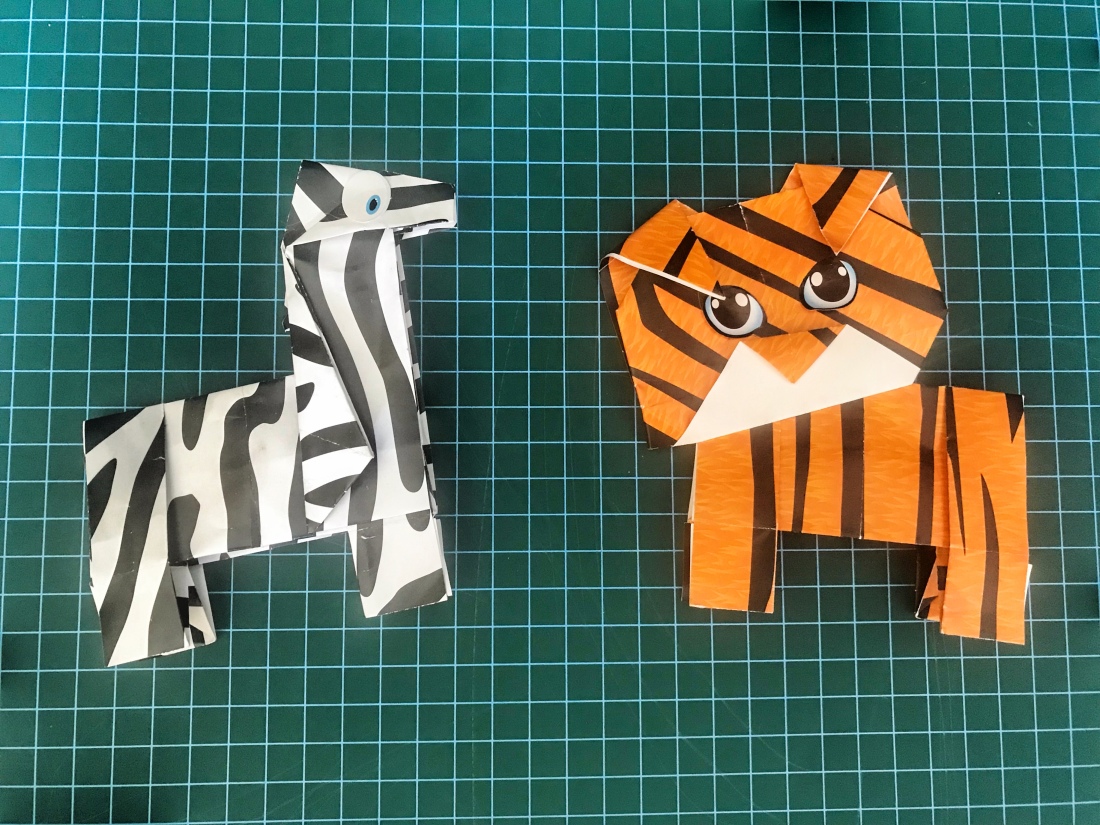
Origami Zebra and Tiger

Here is another origami instruction from Monday Arts Live, this time a zebra and tiger!

You will need:

2 squares of paper and a surface to work on
Pritt Stick
Paint, palette & brushes if you are decorating your paper with paint, or you can use pencils, felt tips or ink.

How to make your lion:

  1. For your zebra decorate two of your squares of paper with black wiggly stripes and the same on orange paper for your tiger.
  2. Follow the instructions below for how to fold, or follow the link to our Facebook Art Live video for how to decorate your own paper.

Eva Stamps!

This week at Heathlands we have been making stamping blocks! These are really simple to create and are a great way of getting creative and decorative with your crafts.

We’ve made our stamps to be interchangeable, meaning that the number of stamps you can create are only limited by the scale of your imagination.

To make your stamps you will need:

  • Eva foam / funky foam
  • Sticky back velcro / hook and loop tape
  • A block of wood
  • Staple gun
  • Scissors
  • Pencil / pen

To use your stamp you will need:

  • Flat paint tray
  • Poster paints / acrylics
  • Paper / material to stamp on

How to make your:

  1. Stick the hook side of your velcro onto your wooden block.
  2. Staple to secure at each end.
  3. Draw your desired shapes for your stamps onto the eva foam making sure not to make them any larger than the block of wood.
  4. Cut out your shapes and add the loop (soft) velcro tape onto the back. Remember that your stamp shapes will reverse or “mirror” when you are stamping. So draw letters and numbers the wrong way round.
  5. You are ready to print! Pick your favourite paint colours and add an even layer to your stamp and get printing. You may need to gently rock your stamp to get it even.
  6. Remember not over load your stamp or it will slide.
  7. Have fun!

Other idea’s for simple stamps include: leaves, flowers, simple shapes, birthday balloons, snowflakes and Christmas tree’s.

Origami Giraffe

We’ve been working on our origami again here at Heathlands. This week we’ve decorated paper and folded a giraffe. You can follow our instructions below and watch our live video as well.

You will need:

2 squares of paper and a surface to work on
Pritstick
Paint, palette, brushes and a sponge if you are decorating your paper

How to make your giraffe:

  1. Decorate your squares of paper with a yellow fur texture, allow this to dry, then use a rough sponge and brown paint to create splodges for your giraffe.
  2. Follow the instructions below for how to fold, or follow the link to our Facebook Art Live video.

Country Slice Cake

Ingredients:

215g self raising flour

22g butter

200g caster sugar

1tbsp cornflour mixed with 3tbsp of cold water

3 eggs

1tsp vanilla extract

80g sultanas – soaked in hot tea for 10 minutes and drained

Sugar crystals to sprinkle with

Instructions:

  1. Preheat oven to 160°C (fan)
  2. Beat the butter and sugar together until creamy.
  3. Slowly add the whisked eggs and vanilla extract.
  4. Stir in the cornflour mix.
  5. Add a handful of flour to the sultanas to coat them – this prevents them from sinking into the mix.
  6. Sift the flour into the bowl and fold together.
  7. Put into a lined cake tin and sprinkle with sugar crystals.
  8. Bake for between 45 minutes and 1 hour.
  9. Test with a wooden skewer, if clean, cake is done.
  10. Enjoy!

Ingredients in Bold are allergens

Homemade Breakfast Sauce

Breakfast or brown sauce is a delicious accompaniment to a full English breakfast or a simple sausage sarnie, and while there are a couple of unusual ingredients, it’s really easy to make! 

This recipe requires a food processor, smoothie maker or stick blender.

Ingredients:

1tbsp oil

200g chopped onion

200g dates or prunes halved

600g cooking apples, cored and chopped, there’s no need to peel them!

500ml balsamic vinegar

200g muscovado or dark soft brown sugar

3tbsp tamarind paste

40g root ginger peel and chopped

4 cloves

1tsp grated nutmeg

2tbsp Worcestershire sauce

Add a couple of chillies or a good dash of tabasco to add a kick to your sauce.

Method:

  1. Heat the oil and gently cook the onions with a pinch of salt for 10 minutes.
  2. Add all the other ingredients, mix well and simmer for 30 minutes.
  3. Blend together. Be careful transferring the mixture, it will be very hot!
  4. Put into sterilised jars and leave for a week or two to mature. This can be stored for up to 6 months.

Origami Diwali Boat

What is Diwali?

Diwali [or deepawali] is the Indian festival of lights, usually lasting five days and celebrated in the Autumn, in the Hindu Lunisolar month Kartika, mid October to mid November.

The festival is widely associated with Lakshmi, goddess of prosperity and it celebrates the victory of light over darkness, good over evil and knowledge over ignorance. Diwali is also a harvest festival, and is different from many other Indian festivals in that there is no fasting, but instead feasts celebrating the seasonal bounty.

Other traditions include cleaning or decorating homes, prayers and rituals and one of these is lighting Diyas. Diyas are small oil lamps, that are often floated on the Ganges river, during Diwali they represent enlightenment, knowledge or wisdom. Floating on a river these appear like little boats.

So we thought making a floating boat for our origami instruction would be perfect coming up to the festival. This year is between the 12th and 16th of November.

Remembrance Day Poppy Origami

Here at Heathlands we are very proud of the support our members have given to the poppy appeal over the years. For many years now we have staffed the poppy appeal table at our local ASDA but due to restrictions this year we cannot. So instead we are making poppies to sell here!

Here are our origami instructions for you to make your own poppy at home. We will update the post with a video when it has been loaded to YouTube.

You will need:

x1 15cm square of red paper

x 1 10cm square of black paper

How to make it:

1. Fold your red paper in half lengthways in both directions and then again diagonally. Four folds in total. Repeat this with your black paper.

2. With your paper in half diagonally, fold in the widest points to match the top points. Again repeat this for the black piece.

3. Insert the black piece of paper into the red as above, taking care to make sure all the folds match.

4. With the closed folds facing towards you and the open end away, turn up each flap, folding it to the middle. Repeat this, turn your work over and repeat again on the other side.

5. Fold your work in half from top to bottom, so the top point meets the bottom.

6. Open this fold out so that the top layer goes up, the next layer turns outward and the bottom layer remains down.

7. Flatten out your poppy and turn back the points of the petals and points on the centre to “round” the flower off.

And your poppy is complete!

Hallowe’en Pumpkin Soup

This warming soup is spooktacular for hallowe’en night. It’s also lactose and gluten free! If you can’t get a pumpkin, you can substitute with butternut squash.

Ingredients:

1 medium or large pumpkin depending on how many you are cooking for

1 white onion

2 carrots

1tsp salt

1tsp ground ginger

1tsp ground cinnamon

Vegetable stock cube

1 tbsp  olive oil

200ml coconut milk / lactose free cream

Method:

  1. Finely dice the onion and start to gently fry with your olive oil in a large soup pan.
  2. Prepare your pumpkin by removing seeds, ect and skin, dice and add to the pan.
  3. Peel and dice the carrots and add to the pan. Keep stirring as you fry and add your spice, cook for around 5 minutes.
  4. Boil a kettle and add water to the pan, so that the vegetables are covered by 1-2 inches of water. Simmer for 1/2 an hour.
  5. Blend your soup using a food processor or stick blender.
  6. You can add coconut milk or cream for a little luxury and if you’re feeling fancy, why not try a spiders web like in the picture!

Origami Puppy

This origami fold is a little more complicated than previous activities we have done, but the extra work is definitely worth it!

This week for our paper folding, we thought it would be fun to make a little decorative friend. All you’ll need is a piece of square paper and two googly eyes.

To make your own cute puppy friend follow video and the instructions below:

Gluten / Lactose Free Plum and Rhubarb Crumble

This delicious classic dessert is warming and seasonal. Plums are perfect this time of year and rhubarb is still plentiful. We served with ice cream, but custard would be awesome too!

We’ve made this recipe using the cup quantity method, just like our Easy Peasy Chocolate Cake!

Ingredients for filling:

2 cups plums halved and de-stoned

2 cups rhubarb roughly chopped

⅓ cup of gluten free flour

⅓ cup of brown sugar

Ingredients for crumble topping:

⅔ cup of gluten free oats

½ cup of dark brown sugar

¼ cup of gluten free flour

3tbsp set coconut oil

1tbsp vegetable oil

1tbsp cinnamon powder

½ tsp sea salt

Flaked almonds to decorate if wanted

Method:

  1. Pre-heat oven to 190 degrees C
  2. In a medium pyrex dish or deep oven pan, gently combine the filling ingredients.
  3. For the crumble topping. Combine all the ingredients, rubbing together until it is crumbly!
  4. Sprinkle it over the filling and bake until the crumble topping is deep golden brown and the filling is bubbling. Around 40-45 minutes.
  5. Set aside to cool for 15 minutes before serving and enjoy!
  • Ingredients in bold are allergens.

Cauliflower Cheese Soup

This delicious take on a Sunday dinner classic is vegetarian and gluten free! You can garnish as you see fit, we served with croutons [not gluten free!], but you could add some chucks of cheese or even some crispy fried onions.

Ingredients:

1 medium onion finely chopped

½ cauliflower roughly chopped

3 cloves garlic finely chopped

1 gluten free stock cube

150g of mature cheddar cheese

Method:

  1. Add a little oil to a large saucepan and gentle fry the onions for a minute.
  2. Add the cauliflower and garlic and gently fry for 3-4 minutes.
  3. Cover with boiling water and add the stock cube. Simmer until the cauliflower is soft.
  4. Blend with a sick blender or in a food processor.
  5. Stir in your cheese until melted and serve!

Paper Airplane

We are back with another installment of our paper folding activities!

This week we’ve made some durable paper airplanes. These are made with standard A4 paper. You could even “up-cycle” a piece that’s already be printed / drawn on and no longer in use. Or why not decorate your paper before you fold?

Our YouTube video shows you how to make your own plane or you can follow the instructions below.

Happy flying!

Gluten Free Orange and Almond Cake

At Heathlands we pride ourselves in seeking out and perfecting recipes for individuals with allergies. This is one of those recipes, developed by our amazing volunteer David.

*** Please note that this cake includes NUTS

This surprisingly light gluten free cake is packed full of flavour and definitely worth the extra time needed to make it.

Ingredients:

2 Oranges washed & chopped in pieces, skin & pith as well as flesh

5 Eggs separated into yolks and whites

200grs Unrefined golden caster sugar

225grs Ground almonds

Decoration Flaked almonds and icing sugar

Method:

  1. Preheat oven to 160°C and line 2-3 loaf tins with paper.
  2. Place chopped Oranges in pan with a little water. Cover and stew gently till soft and liquid has evaporated. Leave to cool. Liquidise in processor or use a small stick blender (Whatever you have).
  3. Whisk egg whites till stiff then gradually add half the sugar to create a meringue.
  4. Whisk egg yolks with remaining half of caster sugar till pale and thick.
  5. Gradually whisk in the pureed oranges to the egg yolk and sugar mixture then fold in the ground almonds.
  6. Gradually fold in the meringue.
  7. Now gently add the mixture to the lined loaf tins. Level the tops, sprinkle on flaked almonds and bake. 
  8. Cool on drying racks.
  9. Remember, if necessary cover. Oven time always varies dependent on the oven but look for 40mins to 1hour.
  10. Enjoy! We like this with a cup of tea.

Leaf Animals

Be creative and make a critter!

For this activity you could collect leaves from your own garden or perhaps collect some if you are going for a walk. Please remember to follow government guidance during COVID-19. You can find more information here.

We have made this short video on how to make a leaf animal for you. All you need is a variety of leaves, a few sticks, a couple of googly eyes and your imagination!

Have fun!